Skyline Photography Unlocks Urban Beauty Like Never Before
March 02, 2026

Discover how photographing city skylines transforms familiar views into works of art, revealing the dynamics and aesthetics of the metropolis through the lens.
The urban environment through the lens is a complex algorithm of light and space intersections. Skyline photography acts as a decoder, extracting hidden visual information from the concrete jungle. It captures moments of transformation from architectural static to dynamic, turning the panorama of the metropolis into a unique digital or film imprint of time.
Unlike the classic approach to shooting cityscapes, this method focuses on the borderline state of the horizon and man-made structures. Creating skyline-style photographs cuts out the hustle and bustle of everyday life, forcing the viewer to focus on the mass, volume, and how light falls on the edges of giant structures. The city acquires subjectivity, transforming from an environment filled with everyday life into a grandiose engineering artifact, frozen in an eternal dialogue with the horizon.
Your AI-Powered Photo Editor for MacOS and Windows
Discover Now!Don’t feel like reading the whole breakdown? We’ve pulled together a quick summary below.
Key Takeaways
Skyline photography is about mass and rhythm, not details. It simplifies the city into one coherent shape, where the gaps between towers matter as much as the towers themselves.
Gear matters most for dynamic range and stability. A body that holds detail in shadows and highlights, a wide lens (12-35mm) for monumental layering or a 70–200mm for distant compression, plus a tripod, polariser, and spare batteries/cards.
Blue hour gives the most balanced skyline exposure. It matches sky brightness with building lights, reducing blown windows and heavy shadow blocks while keeping colour natural.
Weather can “polish” the atmosphere, especially post-rain clarity, humidity shifts, and cloud cover that acts like a diffuser and adds volume to the sky.
Composition is built on structural axes and horizon placement. Use roads or embankments as vectors toward landmarks, add a foreground layer for depth, shift the horizon off-centre to control density, and frame with surrounding elements to cut visual noise.
Changing angles reveals hidden patterns. Low angles exaggerate vertical dominance, elevated platforms show planning logic, and diagonals/side angles inject motion that a straight-on horizon often removes.
Post-processing should tighten materials and edges. Bracket exposures when point lights blow out, use dehaze to recover distant contrast, remove chromatic halos along rooflines, and apply microcontrast to make silhouettes feel solid without warping geometry.
Final Verdict: Treat the skyline like architectural design—chase balanced light, simplify the frame, and refine edges in post so the city reads as one monumental, intentional form.
Understanding the Art of Skyline Photography
 Skyline photography is at the intersection of architectural minimalism and large-scale area art. Its specificity lies in distancing itself from small details in favor of studying the overall shape and contours of a metropolis. In this space, the city appears as a single mass, where aesthetics are determined not by individual bricks or windows, but by the rhythmic alternation of tall dominant structures and the gaps between them.
To create this kind of photograph, you need to find the answer to just one question: why does the jungle of glass and concrete come to life under the influence of light and shadow? When the photographer realizes that there is no room for chance here, and that each frame is the result of a skillful combination of urban topography and natural forces, he is ready to take a step into the skyline genre.
Essential Equipment for Capturing Urban Landscapes
The basic set of tools for creating authentic city panoramas is not much different from the kits used in conventional photography. The basis is a camera with a high dynamic range or a reliable ISO value, capable of capturing details both in the deep shadows of concrete canyons and in the bright glare on glass facades: the Sony A7R V with its 61-megapixel sensor or the Nikon D850 with its best-in-class base ISO 64 are perfect for this.
Wide-angle lenses, 12-35mm lenses, “flatten” the perspective, creating a monumental effect of buildings layered on top of each other.  Therefore, they are quite often used when shooting in the Skyline style, but there are other options. Telephoto lenses of 70-200 mm are also suitable if the subject is at a great distance.
Must-have accessories for shooting: a tripod will help avoid blurring when using long exposures, a polarizing filter will reduce glare on building windows and water, and spare batteries with memory cards will prevent you from missing a shot because you have nothing to capture it with.
Shooting conditions often prevent you from achieving the perfect result due to factors beyond your control. Therefore, perfectionists will find it useful to have an advanced photo editor with built-in artificial intelligence that can refine a photo in just a few clicks.
Best Times and Lighting Conditions for Skyline Shots
 The optimal conditions for capturing the city skyline occur during the “blue hour”, when the brightness of the sky and the intensity of artificial lighting on buildings are balanced. This avoids shadows and overexposure in windows, creating a technically balanced source with natural color reproduction. Accurate exposure calculation during this short period minimizes the need for aggressive retouching, preserving the physical authenticity of architectural volumes.
Special weather conditions, such as high humidity or a sharp drop in temperature after rain, increase the transparency of the atmosphere and eliminate thermal distortions in the air. Cloud cover adds the necessary volume to the frame, acting as a natural diffuser for the rays of the setting sun.
If, after the scene has been captured, you still feel that something is missing, then open the editing application. No, seriously, AI photo editing software can improve an image in just a few moments: apply a soft filter to even out the light, remove unsightly elements of buildings, or even change the time of day.
Techniques to Enhance Composition in Skyline Photos
 A competent composition begins with identifying the structural axes of the city. The linear perspective created by roads or embankments acts as a vector that smoothly directs the viewer's gaze to the main high-rise landmarks. At the same time, the inclusion of objects in the foreground lets you set the desired distance: thanks to this, the flat view of famous skylines is transformed into a multi-layered space with a clear division of scales.
The balance of the frame is built on the precise ratio of architectural mass and sky. Thus, a deliberate shift of the horizon line from the center helps to control the density of the image, making it possible to focus attention either on the buildings themselves or on the overall atmosphere. As a finishing touch, it is worth using elements of the surroundings for natural framing. They effectively cut out extra visual noise and help to organize the complex rhythm of the metropolis.
Infuse Your Photos with the Radiance of Golden Hour Light
Take a lookUtilizing Different Perspectives and Angles
 The selection of non-standard shooting points enables a radical change in viewing distance and the capture of subtle structural connections within the metropolis. For example, the use of a low angle emphasizes the vertical dominance of buildings, while working from elevated platforms makes it possible to document the planning logic of entire neighborhoods. This change of position clears the urban environment of stereotypical perceptions: it becomes a pure object for architectural analysis.
The variability of viewing angles, in turn, helps to reveal hidden patterns in the layering of facade planes and volumes. The use of diagonal compositions or side angles introduces a dynamic into the frame that is usually lost when the horizon is strictly frontal. Ultimately, by walking just a few meters and leaning more than usual, you can accidentally find a shape that passersby are completely unaware of.
Post-Processing Tips to Highlight Urban Beauty
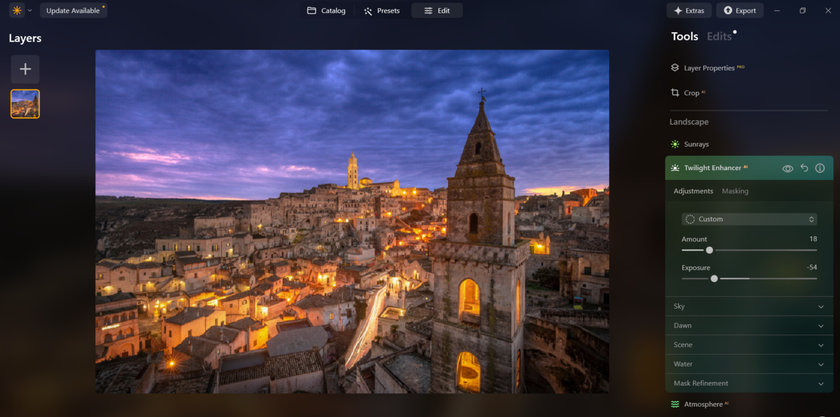
The final stage of working with the frame involves technically aligning light and color flows. Basically, your goal is to make the structural materials look more detailed: glass and metal should be natural, without any weird glare. Using Skylum's landscape photo editor, you can tweak the microcontrast and highlight architectural shapes without messing up the natural geometry of the space.
Exposure bracketing. Combining several frames with different exposures helps avoid “blown out” pixels in point light sources. This technique is not used very often, but it helps preserve details in deep shadows.
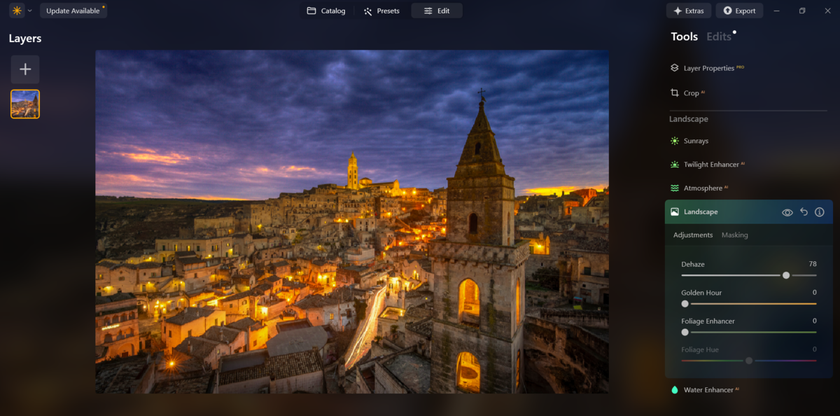
Haze removal. The “Dehaze” tool restores contrast in the background, revealing the clear contours of buildings. This is useful in situations where a beautiful shot is hidden by urban smog or humidity.
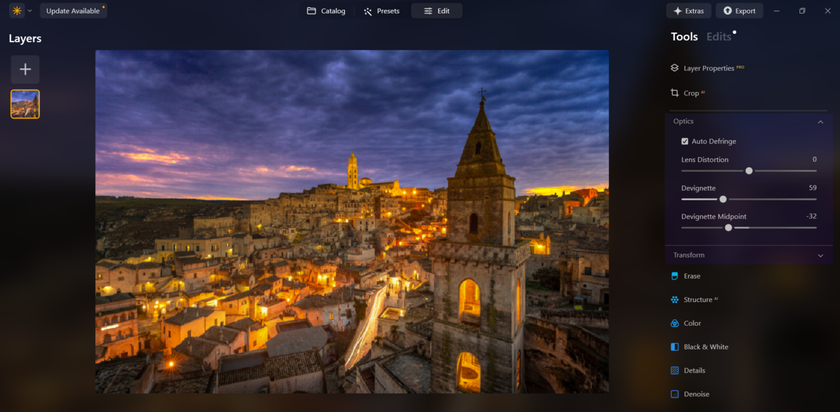
Chromatic contour control. In most cases, processing will require the removal of colored halos at the boundaries of dark roofs and light skies. They add sharpness and reduce the degree of “professionalism,” so if the goal is a clean shot, they are enemy No. 1.
Microcontrast of edges. To make architectural forms a little more rigid and tangible, you can tweak the roughness parameter. The volume achieved in this way looks more aesthetic and smoother, so this stage requires special attention to detail.
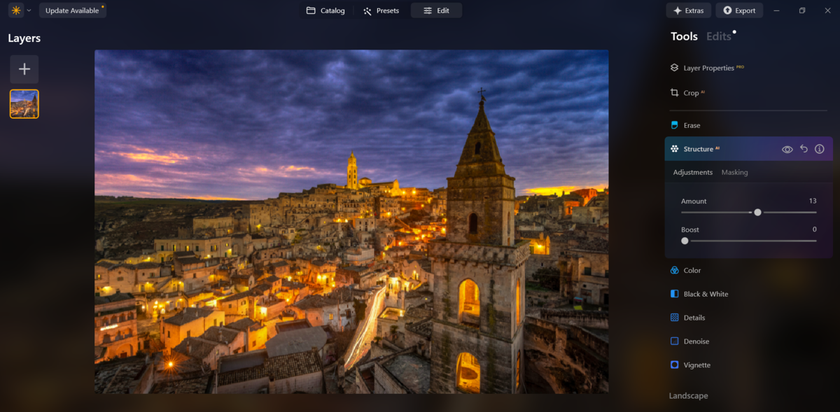
Balanced editing emphasizes the rhythm of verticals and the materiality of objects, whether it's the cold shine of facade panels or the matte texture of concrete. When the technical nuances are perfected, the image ceases to be just a set of pixels and takes on the weight characteristic of large-scale architectural projects.
Safety and Ethical Considerations in Urban Photography
 Shooting in a metropolitan area requires careful attention to private property laws and rules for accessing sites. When planning shots from high platforms or residential buildings, it is worth agreeing with the administration in advance: this guarantees safety and also helps avoid legal complications.
The ethical side of the process is also meaningful, so it is worth avoiding looking into the windows of residential apartments. If extra details, people, or private information accidentally get into the frame, this issue can be easily solved with software, making it possible to focus on the architectural grandeur of the city without violating the personal space of its residents.
Exploring Iconic City Skylines Around the World
 An analysis of iconic panoramas from around the world confirms that capturing the urban skyline is a way of systematizing the visual achievements of civilization. The entire process, from selecting complex equipment to final corrections, is aimed at revealing the structural harmony of a metropolis hidden behind its scale. As a result, skyline photography acts as a link between architectural design and its artistic perception, letting us preserve the unique graphic code of each city and see our familiar environment as a coherent, monumental work of art.